
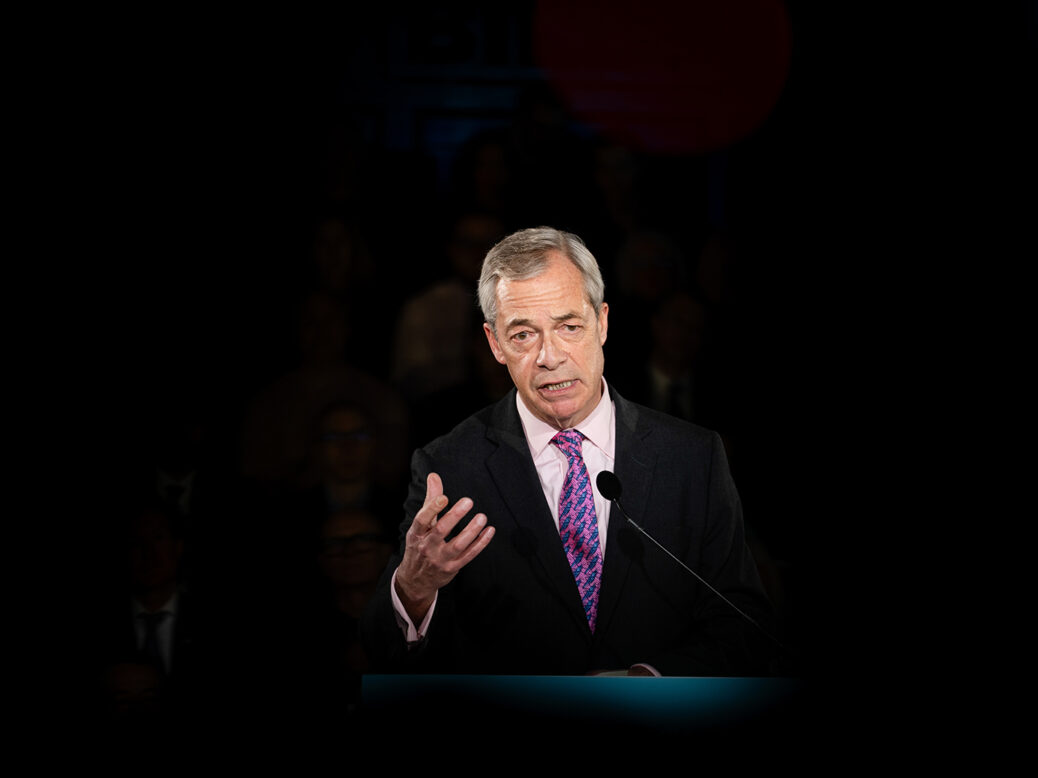
Gary Stevenson
There is currently only one force in politics that has a clear, simple, widely known and easily understood message about why living standards are falling, and how they can be stopped from doing so. Until and unless another voice in politics or media manages to answer those questions in a clear, simple and widely understood way, the hard right will keep winning elections, both here and across the world.
If you want to win elections, you absolutely have to centre the economy and living standards, and you have to have a clear message on how you will do that. There is only one competing message that can win here: the problem is billionaires, the problem is inequality, and the only way to solve it is tax. It has the convenient side effect of being true. Tax wealth, not work. Start backing that message or start preparing for Farage. Good luck.
Gary Stevenson is an author, YouTuber and former trader
Ian Dunt
The way to stop Reform is to govern properly. It’s no more complicated than that. There’s no need for tribal Westminster games. No need for vacuous strategic gibberish about breaking left or right. There’s no great Farage-shaped riddle to solve. He is simply the beneficiary of a political system which has failed to improve people’s lives. If you succeed in improving those lives, he will stop benefiting.
We have endured a rolling series of crises over the last 18 years, starting with the financial crash, stretching across austerity, Brexit, Covid and Ukraine, and culminating in the clown-car suicide festival of Liz Truss. We are now experiencing failure across almost the entire policy portfolio: social care, prisons, growth, housing, healthcare, productivity, innovation, connectivity, regional equality, immigration, homelessness, defence, constitutional resilience.

It is not easy to govern properly, but it is not impossible, and we should stop pretending that it is – or that it is somehow a distraction from the job of planning election campaigns. It involves clear, evidence-based departmental goals, regular progress assessments, and clear lines of communication between special advisers, civil servants, ministers, the Treasury and No 10. That’s how you reduce A&E waiting times, establish defence autonomy, improve transport links and eliminate homelessness. We know that because we’ve done it before.
Most of all, this requires a prime minister who can lay out a vision of what they want, select policies that reflect that vision, and signal clearly to the civil service and the cabinet what it entails.
Make choices, deliver on them, stand on your record. The old ways were the best ways, and we came undone when we departed from them.
Ian Dunt is a British author, political journalist, and broadcaster.
Jeremy Corbyn
The great dividers want you to believe that the problems in our society are caused by minorities. They’re not. They’re caused by a rigged economic system that protects the interests of the super-rich. The rise of Nigel Farage has accompanied a horrendous spike in racist abuse across the country, including Islamophobic and anti-Semitic attacks. We need to document all the attacks that happen everywhere and we need to stand up to all forms of racism.
We are at a dangerous moment in this country, but we can turn the tide. There are millions of people who support a vision of public ownership, rent controls, council housing, a National Care Service, and a budget that looks after the poor instead of funding endless war. Many of them, though, simply do not believe they have a voice or role in politics at all. That’s why Your Party is about to set up branches across the country; to mobilise a new wave of support for a radical alternative, and to build a new kind of community-based politics that empowers local people to fight back.
Our movement is huge, but it is divided. There is only one way we will defeat Reform: by working together under a progressive umbrella that unites progressive anti-racist forces everywhere. When the left comes together on crucial issues of economic redistribution, climate justice and peace, we can – and will – win. Alone, there is only so much we can achieve. Together, we can change British politics forever.
Jeremy Corbyn is the leader of Your Party
Daniela Gabor
Labour governments must stop tinkering with our financialised economy – a status quo in which wages don’t cover bills and rent consumes half of people’s pay because private equity financiers are extracting value from housing, care homes, water, the NHS, energy and railways. That’s what’s fuelling right-wing insurgencies. This is how they are stopped: by tackling the affordability crisis through public ownership of essentials – energy, water, housing. We have blueprints for public control from civil society groups. The task is to use them.
Stop worrying about bond vigilantes and learn instead to value public power over fiscal space. The question of how governments pay for transformation is often reduced to a simplistic answer – “tax the rich”. While that improves distributional justice, it does not resolve the deeper institutional constraints on transformative public investment. Our financialised pension funds are planning to dramatically reduce their holdings of gilts. The Bank of England is deliberately increasing public borrowing costs through aggressive gilt sales, despite warnings from bond investors. Excessive reliance on index-linked debt further forces governments to compensate bondholders for higher inflation. Last year, the combined fiscal hit from their actions and inflation-linked debt exceeded £50bn – paid for out of welfare or education budgets.
These constraints are reversible political choices. We should reorient the pensions bill to mandate greater investment in gilts and public essentials, and enlist the Bank of England in exiting from index-linked gilts. We should also recognise that the Bank is independent but not neutral – an institution run by technocratic orthodoxies that are often conservative in effect, and which can function as a veto over transformative economic ambitions under the cover of independence. Contrast this with the nominally independent US Federal Reserve, which has bought around $40bn in government bonds monthly since December 2025, helping to stabilise public debt markets in the face of bond-market volatility linked to Trump’s chaos. Yes, the illusion of absolute central bank independence is fraying. But we shouldn’t allow authoritarian politics to dictate the future direction of monetary policy or the wider economy. What is needed is a new model of democratic central banking – coordinated with the Treasury – that is oriented towards serving collective social needs.
Daniela Gabor is an economics professor at Soas
Barnaby Raine
It’s almost half a century since Stuart Hall warned that Thatcher had a philosophy of life while the left had only a narrow, technocratic list of policies. Now a new right speaks to dying high streets and popular feelings of abandonment by naming identifiable enemies: a political class that feels virtuous when it dines out on foreign aid, green taxes and benefits for immigrants that all – here goes the story – cost the ordinary taxpayer dearly. Nigel Farage’s solutions are feasible, and they give a bloody nose to unlikeable elitists. But they would leave most people working longer hours for less, while a few cream off the profits – and increasingly donate to Reform. The fake populism of the right is a strategy to defend a society decaying because of inequality, where those who live on asset wealth enrich themselves at everyone else’s expense. Rather than dividing politics into “culture wars” versus “economic issues”, “class” versus “identity”, the left must craft a politics of material freedom that unites these domains: free time to care for our loved ones rather than endless toil; good homes and green spaces rather than dying or gentrifying neighbourhoods; community rather than isolation and exhaustion. That requires collective control over land and the increasingly automated sources of wealth. And it means seeing that the only sick culture destroying our society is the millennium-old predatory ethic of the British ruling class.
As John Maynard Keynes saw in the ashes of war in 1918, the whole order of 19th-century Britain, with its bankers and colonial officers, had to come crashing down, and something different had to be planned. Now the whole West is in crisis while China marches on. In the ruins of Gaza, Western civilisation’s moral claims ring utterly hollow. Farage is not nearly radical enough: the civilisation he defends is on the way out, thankfully, and we must ask what to build in its place.
Barnaby Raine is an English historian and activist
Ben Ansell
The best way, maybe the only way, to halt Reform’s rise is to end its sense of inevitability, to stop defections from the Tories. This shouldn’t be that difficult. While Reform is leading the polls, it is far from running away with it. Its performance in the local elections should have been viewed as slightly disappointing. Yes, it won the highest vote share in England, but it lagged behind Plaid Cymru in Wales, and only came third in Scotland. Its estimated national vote share was actually down by five points on the local elections in 2025.
Meanwhile, the Conservative Party is just about alive. While the party’s declarations of a successful local elections season in which it lost more than 500 seats were comedic, it does have some successes to crow about. Importantly, the party’s best results came in wealthy areas, where it expressly identified itself as the anti-Reform option.
It’s this suspicion of Reform among traditional, affluent Conservatives that may forestall a Farage premiership. To those voters he remains a bit “off”. And Reform’s successes were concentrated in those “left-behind” areas that swung behind Brexit, then Boris Johnson, then briefly Keir Starmer, and now Farage.
If Labour and the Conservatives want to defeat Reform, they would do well to try to push political debate away from the culture wars – which split the left and unite the right – to economics, where the left is united and the right is fragmented. Force Reform to make a choice between post-industrial cities and wealthy market towns. The Conservatives can’t win just on voters in Bromley and Hampshire. But they can survive. And that split on the right would be enough to keep Labour in office and the Conservatives back to fight another day, by which time Farage might have aged out of politics.
Ben Ansell is professor of comparative democratic institutions at Oxford University
Will Davies
We need to distinguish two separate issues. Firstly, why is Reform succeeding? Second, how can Reform be stopped? The answers are not necessarily related, at least not in the present political cycle. Reform is succeeding because older, typically less-educated voters outside metropolitan areas have experienced nearly two decades of stagnation and decline in their neighbourhoods and in the prospects for their families. Many have come to attribute this to a “mainstream” political and media elite, whom they accuse of being more loyal to refugees than to citizens. For Labour or other mainstream actors, reasoning with these voters about economics is hopeless. Only a reversal of that economic decline may change anything, which would need to be eye-catching, geographically targeted and appealing to popular sentiment – a kind of left populism that may fall foul of Treasury orthodoxy, given mounting fiscal commitments elsewhere.
Then the question is, how else might Reform be stopped, if not through undoing its underlying socio-economic conditions of success? With less than three years until an election, this is a short-term tactical priority, which needs to be treated as such. The government needs to do whatever it can to switch off the pipeline of billionaire donor money flowing to the party and to clamp down on breaches of electoral rules. Media regulation and political advertising rules need to be far bolder. All parties committed to basic tenets of liberal democracy and rule of law need to come out and say as much now, in preparation for an anti-Reform coalition government. Find ways of mobilising younger voters to join an anti-Reform people’s front. Lessons from overseas indicate that aggressive and disruptive political actors are not defeated in argument, but through hard-nosed political machination and legal confrontation if necessary.
Will Davies is a professor of political economy at Goldsmiths, University of London
Emma Burnell
There are some real, practical actions Labour members – from the cabinet to activists – can all take. First, we should ensure that the easy ride Nigel Farage has received from the media – often wary of being accused of being “out of touch” – comes to an end. How? We may have seen something of a masterclass in that from Bridget Phillipson recently. It might have been overlooked at the time, but the Education Secretary used her position in the BBC running order to demand that Laura Kuenssberg ask robust questions of Richard Tice about the views of some of the new Reform councillors he was celebrating. Labour should keep this pressure on broadcasters to do their jobs properly. Tice – like Farage and all Reform’s national figures – responded with what amounted to patience barely masking irritation at Kuenssberg’s temerity in putting anything other than the most obsequious questions. But too bad, Dick – scrutiny is the heartbeat of democracy. And that is at national level, with a politician as experienced as Tice. It will be up to Labour to keep asking these questions, and to ensure that the media at all levels across the country feels the pressure to scrutinise every Reform official. Many first-time elected representatives may find the attention that comes with public office deeply uncomfortable. Once again: too bad.
The other thing people should do is simply ask those who have been elected to local government for Reform to do their jobs. Because dealing with the avalanche of issues that comes to councillors every day is what local government is actually about. It is not as much fun as trolling opponents on social media. It is a hard grind, and many of those elected for Reform – especially in areas of deprivation, where the issues are more complex – are deeply unprepared for what 90 per cent of their time will actually involve.
If you have a Reform councillor, you should be demanding they do their jobs. Send them the casework, raise the local issues you care about with your elected representative. Hold them to account. Not because you want to defeat them politically, but because it is what they were elected to do. As that reality sets in, the fun of being in Farage’s gang may become a distant memory obscured by the inbox of the average councillor. Nothing wears down a populist fantasist like a heavy dose of mundane reality.
Emma Burnell is editor of “LabourList”
Peter Chappell
Nigel Farage’s Reform is an odd political party, that much we know. Up until February last year, they weren’t even a party at all, but a private company. Their most recent conference saw members claiming vaccines gave the King cancer, Andrea Jenkyns performing a self-penned ballad about insomnia, and Farage coming on stage to pyrotechnics and grime music.
But following the local elections, Reform will have to get less odd. The process of blessing Farage with the holy oils of the establishment, ready for his coronation, will necessitate a change in political style. And those who wish to stop Reform can’t let him get away with it.
The move will have to occur because Reform might struggle to win a majority with the coalition they’ve already built: with polls as they are at the moment, an eventual deal with the Conservatives is looking likely. Their vote share in the locals actually dropped compared to last year. To win big, they will have to appeal to those voters who were reassured enough by Boris Johnson to award him a majority in 2019. There’s still work to do, and a balance between a party of performance and a party of power must be struck.
In my book, What If Reform Wins, I posit a scenario where, in the lead-up to the 2029 election, with Farage ahead, significant parts of the corporate world, media and Westminster swing behind the party. It’s the natural order of things in British politics: think Rachel Reeves and her “smoked salmon offensive” before the last election. It’s part of the Reform strategy too: Richard Tice has been pitching hard to big business in the City with speeches at Bloomberg, Farage has taken on a series of former Tories to provide “experience” to the party, and they’ve junked promises of tax cuts to reassure markets. It’s starting to work. People are already thinking and planning for the practicalities of Zia Yusuf as Home Secretary and James Orr in Downing Street. Some even didn’t want to publicly endorse my book because of the likelihood.
There’s hope here for those who wish to stop Reform: Farage’s low personal popularity ratings hint that voters still can’t quite see him in No 10. But it’ll be the job of opposition parties to convince voters that, far from being everyday men of the people, Farage and company are just the opposite.
Peter Chappell is the author of “What If Reform Wins“
Ryan Wain
Reform is offering voters the chance to blow up the system. When that system is producing the highest postwar tax burden, porous borders, poor public services and a persistent cost-of-living crisis, the idea of blowing it up becomes appealing.
The response should be to offer a controlled explosion – not incrementalism, and not a retreat into the comfort of a “progressive bloc” or the easy deployment of a “rejoin the EU” policy lever, but a deliberate, disciplined dismantling of Britain’s status quo. In other words: radicalism from the centre.
This would be a political project driven from the top of a government confident in its identity and ready to use its majority, mobilising civil society, universities, businesses and leaders across the UK. Internationally, it would eschew the right’s isolationism and understand the world we’re in, where might comes from economic, scientific and military power.
A nimble, active state would build this with record defence spending which drives innovation and an unprecedented training programme – dragging young people off benefits to develop dual-use skills that can be deployed in war and gainful employment. It would harness the AI revolution, mobilising our too readily denigrated world-class universities to spread gains throughout Britain and ensure it creates more jobs than it destroys. It would transform every public service with a consistent approach to reform: data-driven, personalised, preventative, real-time. This would reduce costs and enable people to live healthier, happier lives. The obesity epidemic would retreat as weight-loss drugs roll out beyond those who can currently afford them.
A controlled explosion would extend to politics itself, challenging those parts of the left that accommodate extremism for political gain and championing merit over identity politics. It would restore purpose, building confidence that the country can realise its extraordinary potential and renew itself.
Ryan Wain is senior director at the Tony Blair Institute
Alex Niven
To stop Reform you’re going to need a bold, ideologically uncompromising project to rival route-one right-wing populism. Starmer’s problem is that his sense of self is based on being a “sensible”, post-ideological return to equilibrium after the Corbyn years – and he’s oriented his government around this stance. It’s unfit for an era of permacrisis, national decline and growing constitutional fracture.
It may be too late to stop the rot, but in the short term it’s hard to see how anything but an Andy Burnham-led Labour Party has any hope of doing so. The Greens have the ideas and the righteous energy, but under first-past-the-post they have very little chance of bettering the 200-plus seats Labour held under Corbyn, when it was a largely powerless opposition. Burnham is not the Messiah – indeed he’s a deeply flawed character – but he has the basis of a gutsy reformist agenda with a fighting chance of cutting through across the nations and regions, including in new Reform heartlands such as County Durham and South Wales. As Greater Manchester mayor he has pulled off transformative grand projets, advocating for constitutional reform and civic regionalism as antidotes to ethno-nationalism, and, in doing so, achieved popularity among disparate demographics. If you want to win a parliamentary majority (or plurality) capable of blocking Reform and stealing its populist thunder, this is the only formula worth a shot.
Alex Niven is an editor at the Alameda Institute
Suzanne Moore
One: understand that the right has been much more agile about identity politics than the left. The new demographics do not fit the old mantras of gender, race or class. Two: these new identities point towards devolution and the necessity of talking about Englishness. Don’t keep ceding that territory to Reform. Three: years ago, I followed Nigel Farage around Thanet. The men there knew: “He is a bastard. But he is our bastard.” The women were not so sure. Women – the producers and consumers of public services – understand the complexities of the arguments around immigration better. Appeal to them. Four: stop despising those you seek to represent: racists and “gammons”. This is exactly what happened with Brexit. Listen to their radical grievances. Five: encourage more Tories to defect. It makes Reform look pathetic. Six: Labour has a huge majority. Push for proportional representation. It’s now or never. SOS! Seven: never stop asking about their finances. Or Donald Trump. Or Vladimir Putin. Or defence. Eight: hold local Reform councils accountable. It’s dull but necessary. Nine: focus on Farage’s mouth – it’s black inside, a hellmouth if ever I saw one. I wasn’t even on drugs when I glimpsed this: a gateway to the fiery depths of damnation. Ten: you know the WB Yeats line, “Things fall apart; the centre cannot hold.” Yes. But focus on the preceding line: “The falcon cannot hear the falconer.” We have to choose to be the tough, skilled falconers “in the widening gyre”. We have to reconnect.
Suzanne Moore is a columnist at the “Telegraph”
Daniel Trilling
Nigel Farage’s Reform is in a weaker position than its recent advances suggest. Since the start of 2026 the party has made efforts to show it has more to offer than anti-immigration posturing, seeking in particular to attract a layer of more moderate voters, and that it is more than a one-man show. Neither aim has been convincingly achieved. Farage’s announcement, shortly before election day, that a future Reform government would place its deportation centres in areas that vote Green had the whiff of desperation about it.
Parties like Reform thrive on a simple yet powerful promise: that pride and security are to be found in meting out punishment to national enemies. It appeals to some because we have spent several decades being told by our political class that there is no alternative to neoliberalism, a philosophy that places market forces above politics and divides people into winners and losers, but which has been exposed as bankrupt by the shocks of the 21st century.
Reform, in a debased and ultimately self-destructive way, offers to restore a sense of community and connection. This is increasingly seductive because it provides an answer to the question of collective welfare on a planet that is becoming more difficult and dangerous to live on. To defeat it, we need a better answer: a redistribution of wealth and power that enables people to survive and thrive by supporting one another, rather than punching downwards.
Daniel Trilling is the author of “If We Tolerate This: How the British Establishment Made the Far Right Respectable” (Picador)
Alan Finlayson
Nigel Farage’s Reform succeeds because it gives words and ideas to people, which they can use to feel they better understand what is happening to them and the country, and can plan action to make it better: the elite did it, because they are stupid lefties who don’t understand the traditions which have served us well; stand by them, raise a flag, vote Reform and do your duty as part of the resistance. That political argument has been developed and propagated online for years, and applied by hundreds of thousands of people to all kinds of issues and local experiences.
Keir Starmer’s Labour is nowhere online. Instead of making arguments and giving reasons it lectures people on what can’t be done (spending more, managing AI), chastising whoever questions them. The Greens have begun to show what happens when you make an argument and invite people to develop a shared worldview.
But politics is bigger than party. Ideological struggle now happens in online culture. To defeat Reform we should support those working there. The right pays subscriptions. The left, not so much. Online creators should collaborate more to create wider support networks. And there needs to be more offline political collective and individual self-education. This isn’t about loudly denouncing Reform. That’s easy. It’s about forming a collective intelligence across the progressive left that can guide common action: not uniform conclusions but shared premises about how society and economy are organised now, and about how to organise and persuade where you live and work.
That’s not leftist indulgence. It’s groundwork. A winning political project is always cultural and intellectual as well as policy driven. Labour tried to deny that and has ended up being the stupid party. But no one force can win against an ever more unified Right. In a break from tradition, left, liberal and progressive will need to find a way to share ideas. Ego and self-interest will lose. We cannot let Nigel Farage win because he was more thoughtful and cooperative than us.
Alan Finlayson is professor of political and social theory at the University of East Anglia
Neil Kinnock
Support for Reform has developed out of decades of disaffection generated by deprivation and the poverty of prospects which it spawned, by perceived neglect of post-industrial areas, and by the resentments of groups alienated by rapid social and economic change for which they were neither prepared nor compensated.
Brexit gave form to this. Farage has provided organisational identity. The resulting “politics of the people” is offered by rich bourgeois nationalists mainly funded by billionaires. There is now willingness to accept simplistic responses to complex challenges. Sophisticated responses are seen as excuses.
In their search for the “politics of the people”, voters are gullibly hopeful rather than appallingly hateful. Bigots are encouraged in the search for “others” to blame and must always be combated. But they are greatly outnumbered by the credulous who look for promises that reflect aspirations.
To stop Reform, the government must act urgently to address the basic feelings of being “left behind” and “stagnating”. The deeds of practical change must be proclaimed and explained (by social as well as conventional media) to show what, why and how tangible improvements are being achieved. Nothing can replace, or be more convincing, than what Labour does in government, and it is vital that the public is told. Whispered advance wins no understanding, generates no hope.
The efforts of renewal are essential for their own sake. But they are also crucial in order to demonstrate that the voters are heeded and not just heard.
In addition to acting, Labour has to attack. Reform and its leadership must be continually exposed for their lying failures, including Brexit, performance in local government, questionable funding, association with Trump, admiration for Putin, demand for UK participation in Trumpkrieg, surfeit of simple promises, and deficit of delivery. It is essential that Farage and his associates are regarded as “just another bunch of bloody politicians” with some extra shadiness and incompetence. It’s the truth. Always the best weapon.
Neil Kinnock was leader of the opposition and leader of the Labour Party from 1983 to 1992
Jack Rankin
Nigel Farage’s support has been with him, in part or in full, for many years now: older, prosperous, primarily male, right-wing Tories frustrated that we so often failed to do what we said on the side of the tin while in government. Immigration, both legal and illegal, surged. Tax and spending crept ever upwards. We indulged in left-wing populism on landlords, and failed to pursue independent democratic self-government with sufficient conviction after leaving the European Union.
Rebuilding trust with those voters will take time, but many can at least see that Kemi Badenoch is the real deal and shares those instincts. But Wigan, Sunderland, Grimsby, St Helens and Hartlepool did not fall because of that demographic. Labour has utterly lost its white working-class base – the people it was founded by and for. Both my grandfathers were part of the labour movement in what is now Tameside, where 18 of 19 wards went Reform last Thursday. They were patriotic family men who believed in the solidarity of working people through community and social democracy. What would today’s average Labour member think of them? It would sneer at them as racist and reactionary for believing that mass immigration has not benefited their communities, that violent criminals should be harshly punished, and that there is nothing shameful about taking pride in this country’s history.
Might I suggest that the Labour Party spend less time trying to answer Tarquin of Islington’s question – “What is the Prime Minister going to do to prevent the trans community of Palestine being adversely affected by climate change?” – and more time working out why a block of Cathedral City costs £6 in Tesco Express and now has to sit in a security box?
Jack Rankin is the Conservative MP for Windsor
Sacha Hilhorst
In its 2024 manifesto, Reform pledged to “end the corruption of our government”. This simple promise spoke simultaneously to a perceived sickness in our political system and to the hope that Nigel Farage’s newest electoral vehicle would act as a tonic. It was an alluring pitch. In the working-class towns where I conducted ethnographic research, many felt that politics had become corrupt. If Reform can credibly present itself as a force against corruption, it stands to reap potentially significant electoral rewards.
But corruption is also Farage’s Achilles heel. In different studies, Hope Not Hate and Persuasion UK both found that Farage being in the pocket of big-money donors was among the most effective frames for dissuading Reform voters and sympathisers. Yet revelations about donations seem to have affected Farage’s image minimally. This is due to the lack of a “clean” alternative. Voters reason that Starmer, too, accepted donations he should not have. After big promises early in his leadership, he backtracked on policies.
Starmer’s successor should lean into political renewal. Except in rare cases, MPs should not be allowed to hold second jobs. The ineffectual 2014 Lobbying Act should be replaced with firmer rules on lobbying, business appointments and ministerial conduct. Ex-ministers should face stronger repercussions for selling access and, in cases of serious transgressions, they should lose their parliamentary pension.
This would allow a leader to establish themselves as a genuine alternative, land blows against Farage and generate goodwill for a transformative economic programme. More will be needed, too – action on the cost of living, progress on waiting lists. But political renewal is a good place to start.
Sacha Hilhorst is an ESRC-funded post-doctoral fellow in sociology at the London School of Economics
Jonathan Hinder
It starts with genuinely listening and understanding. We must stop the sneering and the dismissals, which have never really stopped following the 2016 rupture. In places like Sunderland, Hartlepool, Grimsby, Wigan and St Helens, Reform swept to huge victories last week. Does Labour care? Does Labour really want to win these people back, or is it content to write them off, and abandon them to Farage’s latest band of Thatcherites?
As the New Statesman’s John Gray tells us, “populism” is a term beloved of the liberal elites to describe the blowback against their own policies. It is not an inexplicable, alien force. We can beat Reform if we take the time to understand where their momentum comes from.
The Labour Party remains, despite everything, the best vehicle to defeat Reform. But not in its current state, for the party does not really know the country it seeks to govern. Worse, it does not have the humility to say the truth – we left the working class behind, ditching socialism for identity politics, globalisation and the financialisation of everything.
In reality, it may be too late, but Labour must rediscover its working-class base once again, and a unifying message of economic radicalism, if it is to have a shot at it.
Jonathan Hinder is the Labour MP for Pendle and Clitheroe
Dan Evans
Nigel Farage’s Reform succeeds because it gives words and ideas to people, which they can use to feel they better understand what is happening to them and the country, and can plan action to make it better: the elite did it, because they are stupid lefties who don’t understand the traditions which have served us well; stand by them, raise a flag, vote Reform and do your duty as part of the resistance. That political argument has been developed and propagated online for years, and applied by hundreds of thousands of people to all kinds of issues and local experiences.
For me the twin issues are understanding Reform’s base and understanding why said people are voting for Reform. Labour seem to understand neither. Firstly, the Morgan McSweeney/Claire Ainsley strategy of winning over the working class (in the abstract) seems to have alienated Labour’s new progressive base while also not winning over said “working class”. Tony Blair and Margaret Thatcher understood that the “hero voters” are not the working class but the petty bourgeoisie: the lower middle classes (very often small self-employed business owners) who are being squeezed and broken by the current economic settlement and (justifiably) burning with resentment at people who do not seem to work hard getting stuff for nothing. Labour have thus far totally alienated this group through minimum wage hikes, the national insurance burden, and increasing bureaucracy across the board. Nigel Farage understands this and much of Reform’s pitch is to this group. Zohran Mamdani also did this successfully in New York last year. Labour have to win that group back over.
Next, the reason most people are so upset with Britain is due to hyperlocal symptoms of decay and decline: littering, petty crime, the death of associational civic life (pubs closing down etc). Ultimately people understand the world and politics through their community. Labour’s plans for economic rejuvenation are all huge scale, silver bullet stuff – new nuclear reactors, artificial intelligence tech – and their “Pride in Place” scheme seems flawed. Meanwhile the ultra-left (including the Greens) are so focused on foreign policy and social issues they do not even have the language to deal with issues like crime and anti-social behaviour. Reform yet again understand this and are channelling these grievances very well by talking about stopping the decline of high streets, the rise of the grey economy and so on.
One way of bringing these two issues together (such as peeling off the small self-employed and addressing community decline) would be by focusing on the foundational economy, the local, unglamorous issues rather than the huge white elephant plans Keir Starmer keeps unveiling. Save the high street, revive pubs and clubs, clamp down on vape shops. Create a foundational economy unit, set targets, and just go for it.
Dan Evans is a lecturer in criminology, sociology and social policy at the University of Swansea, and the author of “A Nation of Shopkeepers” (2023)
Charlie Falconer
Nigel Farage is currently, in this scenario, the odds-on favourite to emerge as prime minister after the next general election. Defeating Reform UK means defeating it at the ballot box, at the next general election or the one after that. If Reform becomes the government they will target the checks and balances to make victory all the easier next time round. That playbook has been seen all too often when right-wing populist leaders take power: Viktor Orbán, Donald Trump, Benjamin Netanyahu.
The key protections we will need are: the power of the opposition in parliament to hold the government to account; the power of the second chamber to defend fundamental freedoms; the media that reveal the abuse and corruption in government; the judges which stop governments from breaking the law; the human rights settlement which prevents the government targeting the unpopular and protects all our freedoms; the Electoral Commission which polices the rules of our democracy; the impartial civil service.
These bulwarks will be scapegoated by a Reform government. The constitutional protections need to be strong enough to withstand that scapegoating from a Reform government in control of the making of law.
As a matter of urgency, cross-party work reaching into civil society needs to focus on agreement on where those protections need strengthening. Not because we want to thwart a government illegitimately, but to ensure our constitution is fit for the purpose of defending the values we agree on. And as part of that work there needs to be consideration of whether the strengthening of independence carries with it greater responsibility or transparency from the guardians of our freedoms.
Our constitution is vague, flexible and therefore very open to manipulation by those who want to subvert its purposes. We should not have a prime minister who has unlimited power to appoint any number of new peers irrespective of what the body tasked with considering their suitability may say about them. We should not have a prime minister who can get his majority in Parliament to pass laws to oust the courts’ power to stop him from breaking the law. We should not have a prime minister who can tell the Electoral Commission to stop investigating breaches of democracy’s rules if it embarrasses him. If we don’t protect our constitution it may look very different after one term of a Reform government.
Charlie Falconer served as lord chancellor and secretary of state for justice under Prime Minister Tony Blair from 2003 to 2007
Zack Polanski
After the local elections, it’s clear that the two-party system is dead and buried. One of the big winners was my party, which came second in vote share across the country in an unprecedented election for us. The other winners, of course, were Reform, which capitalised on a feeling of hopelessness and anger that pervades swathes of the country – where people don’t just feel left behind, but have been left behind.
We are living in rip-off Britain. People are struggling under the weight of a toxic combination of low wages and high bills. For years, middle-of-the-road politicians have told people they’re sorry – but things simply cannot get better. It is under these crushing circumstances that snake-oil salesmen of the right, armed with convenient scapegoats, thrive.
But while Reform is on the rise, more people are joining the dots between Farage’s policies – his opposition to workers’ rights, his flip-flopping on NHS privatisation, and his push for more oil and gas drilling – and the donors lining his party’s coffers.
The shine is also beginning to come off a party that looks less and less like a fresh alternative and increasingly like a rehoming centre for failed Conservatives desperate to save their political careers. It is not enough, though, to hope Reform exposes itself as the grifter vehicle its critics describe. We have to show that there are real, hopeful solutions to the deep problems making people’s lives harder – that political action to improve living standards is not only possible, but effective. That means bringing down rents and bills, raising wages, revitalising public services, and making our country more independent and resilient, while showing genuine leadership on the world stage. It also means rewiring the economy so that it works in the interests of the caring majority, not the wealthy elite.
Zack Polanski is the leader of the Green Party of England and Wales
[Further reading: The risks and rewards of Starmercide]
Content from our partners



Related



This article appears in the 13 May 2026 issue of the New Statesman, Never-Ending Chaos
Join the debate
Subscribe here to commentOMG! Glad i chose Florence over London for my culture trip this summer. Britain like the rest of the West is suffering from the onslaught of elites’ (oligarchs’) paid political propaganda that is read and heard as bald face lies by more and more people . The most common reaction above is to beat down in the bud any and all dissent . And unspoken and unwritten, jail a few to project “justice” so everyone knows and obeys.
Across the West the elite’s rallying cry is “How to stop” ______. And behind the scenes, the elites, their administrative state and propaganda screw the public so the merry go round doesn’t miss a beat. This cycle likely will not be broken until we go through a World War and/or Depression.
Hitler and Stalin are rolling in their graves with envy.
Far be it from me to criticize (as an American) UK politics but as someone on the outside, I do wonder – perhaps a prime minister should be elected who focuses on the UK? There have been so many prime ministers since Cameron, and this current one seems to spend most of his time traveling the world and traveling to Ukraine, and talking about Ukraine (not a NATO ally). Perhaps a prime minister (or even a King) who focused on UK matters such as farming, energy, immigration, foreign relations, and just stayed home. The UK has a lot of coal, still has oil deposits, arable land. I would focus on these things if I was UK head of Government or Head of State, and stop traveling to foreign countries to curry favor with heads of state who frankly don’t care.